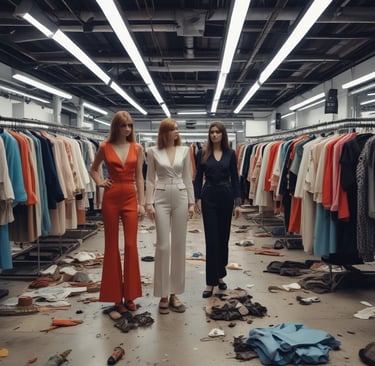
Fast Fashion – Economic Growth or Environmental Disaster?
Fast Fashion – Economic Growth or Environmental Disaster?
1. Warm-Up Questions
Should governments regulate the fast fashion industry more strictly?
Does fast fashion provide jobs and economic growth, or harm the environment?
Should consumers boycott fast fashion brands for ethical reasons?
Can sustainable fashion replace fast fashion without harming affordability?
2. Vocabulary Preparation
Advanced Vocabulary – Match the words to their definitions:
supply chain
ethical sourcing
overproduction
consumerism
environmental footprint
sustainable materials
greenwashing
labor exploitation
A. The process and network of producing and delivering products
B. Using materials and production methods that reduce environmental impact
C. Claiming sustainability while not making meaningful changes
D. Producing more goods than needed, leading to waste
E. Treating workers unfairly or paying below minimum standards
F. Practices that prioritize ethical and responsible sourcing
G. The impact of production and consumption on the environment
H. Excessive desire to purchase and consume goods
Fun Vocabulary Game – "Fast Fashion: Friend or Foe?"
Choose the correct term:
Making thousands of garments that may not sell demonstrates (overproduction / ethical sourcing).
Factories paying very low wages reflect (labor exploitation / sustainable materials).
Advertising a brand as eco-friendly without changes is (greenwashing / supply chain).
Using recycled cotton and biodegradable fabrics is (sustainable materials / consumerism).
The network of suppliers and manufacturers is called (supply chain / environmental footprint).
Encouraging constant buying trends is an example of (consumerism / labor exploitation).
Fast Fashion – Economic Engine or Environmental Crisis?
Fast fashion has revolutionized the clothing industry by offering trendy designs at low prices, transforming how consumers interact with fashion. The model relies on rapid production cycles, responding quickly to consumer demand and constantly releasing new collections. Proponents argue that it stimulates economic growth, creates employment opportunities globally, and makes fashion accessible to people of all income levels. Critics, however, warn that fast fashion causes severe environmental damage, promotes overconsumption, and relies heavily on exploitative labor practices.
According to a 2025 report by the Global Textile Foundation, the fast fashion industry produces over 100 billion garments annually, contributing significantly to carbon emissions, water pollution, and textile waste. Many of these garments are made in developing countries where labor laws are weak, and working conditions are often unsafe. Workers in factories may face excessive hours, low wages, and hazardous environments, highlighting widespread labor exploitation. Ethical sourcing and labor regulation are frequently ignored in the pursuit of speed and profit.
Consumerism drives much of the demand for fast fashion. Shoppers are encouraged to buy frequently due to constantly changing trends, social media influence, and ultra-low prices. This high consumption pattern contributes to overproduction, a situation where more garments are manufactured than sold, creating enormous amounts of waste. In many cases, unsold clothing ends up in landfills, releasing harmful chemicals and microplastics into the environment. The environmental footprint of this industry includes not only the physical waste but also the significant use of water, energy, and synthetic materials that are difficult to decompose.
In response, some companies are attempting to adopt sustainable materials, such as organic cotton, recycled polyester, and biodegradable fabrics. While these efforts show promise, critics warn of greenwashing, where marketing campaigns exaggerate the environmental benefits of products without implementing meaningful changes. Transparency in the supply chain and genuine ethical sourcing are essential to avoid misleading consumers and to make a tangible positive impact.
The economic aspect of fast fashion cannot be overlooked. The industry provides millions of jobs worldwide, from garment manufacturing to retail sales. It contributes to local and global economies by generating revenue and supporting related sectors such as logistics, marketing, and advertising. However, the low cost and high turnover model often comes at the expense of workers’ rights and long-term environmental sustainability. Governments and regulatory bodies face the challenge of balancing economic benefits with social and ecological responsibility.
Innovative solutions are emerging. Some brands have implemented take-back programs, encouraging customers to return old clothing for recycling or resale. Other companies offer limited edition collections or produce on-demand to reduce waste. Public awareness campaigns and consumer education are helping to shift demand towards more sustainable fashion choices, demonstrating that change is possible without entirely sacrificing affordability and accessibility.
Ultimately, fast fashion presents a complex dilemma. It offers undeniable economic benefits and fulfills the modern consumer's desire for new trends, yet its environmental and social costs are considerable. Balancing economic growth with ethical practices and environmental responsibility is critical for the future of the industry. Consumers, corporations, and policymakers must collaborate to ensure that fashion trends do not compromise the planet or the well-being of those who produce the garments. Only through a combination of regulation, innovation, and conscientious consumer behavior can the fast fashion industry evolve into a more sustainable and equitable system.
4. Grammar Practice
A. Cause and Effect Sentences
Rewrite the sentences using appropriate cause-and-effect connectors (because, due to, as a result, therefore):
Fast fashion produces a high number of garments. It contributes to waste.
Factories use cheap labor. Workers face low pay.
Consumers buy frequently. Brands produce rapidly.
Greenwashing is common. Consumers are misled.
Sustainable materials are adopted. Environmental impact is reduced.
Overproduction occurs. Landfills are filled.
B. Conditional Sentences
Complete the sentences:
If consumers stopped buying fast fashion, companies ___ (reduce) production.
Had brands adopted ethical sourcing earlier, environmental damage ___ (be) less severe.
If governments regulated labor conditions strictly, exploitation ___ (decrease).
Should companies increase transparency, consumer trust ___ (rise).
If sustainable materials were used widely, the environmental footprint ___ (decline).
Were greenwashing eliminated, public awareness ___ (improve).
5. Creative Task – "Fast Fashion Reality Show Challenge"
Students are divided into small production teams. Each team creates a mini reality show episode showcasing a fast fashion brand. The task includes:
Scenario: Teams must simulate managing a fast fashion company, balancing profitability with sustainability.
Roles: Assign team members as CEO, sustainability officer, marketing manager, and influencer.
Challenges: Each team faces unexpected situations such as consumer backlash, labor protests, or supply chain disruptions.
Presentation: Record a 3-5 minute video, live skit, or interactive slideshow demonstrating their decisions.
Evaluation: Teams are judged on creativity, realistic problem-solving, use of vocabulary from the worksheet, and persuasive communication.
Twist: Introduce a “public vote” element where the class acts as consumers deciding which brand is most ethical and successful.
This creative task combines role-play, improvisation, teamwork, and critical thinking, making the lesson engaging and dynamic.