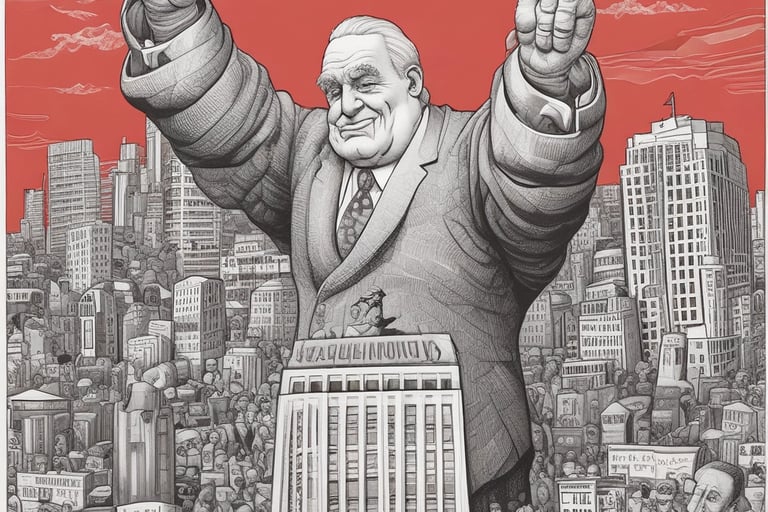

Corporate Influence on Politics
Corporate Influence on Politics
1. Warm-Up Questions
Should corporations be allowed to donate unlimited amounts of money to political parties?
Is lobbying a legitimate form of democratic participation or legalized corruption?
Do multinational companies have too much influence over national policy-making?
Should governments ban political advertising funded by private companies?
2. Vocabulary Preparation
regulatory capture
political lobbying
corporate transparency
dark money
public accountability
policy influence
ethical governance
conflict of interest
A. When political decisions are influenced by hidden financial contributors
B. Pressure campaigns aimed at shaping laws or regulations
C. Responsibility of institutions to act in the public’s interest
D. Excessive corporate control over regulators
E. Open disclosure of business and financial actions
F. A situation where personal or corporate gain affects decision-making
G. Attempts by companies to shape national or international rules
H. Decision-making based on moral and socially responsible principles
Fun Vocabulary Game: "Corporate Angel or Corporate Villain?"
Choose the correct term:
A company refusing to reveal its donors is likely involved in (dark money / bright dollars).
When a minister previously worked for a company he now regulates, it may be a (conflict of interest / conflict of furniture).
A government influenced heavily by corporations might suffer from (regulatory capture / regulatory sculpture).
3. Reading Article
Article Title: Corporations in Politics – Power, Money, and Democracy
Full Article (≈650 words):
In recent years, the intersection between corporate power and political decision-making has become one of the most contentious debates in modern democracies. While businesses have always played a role in shaping public policy, the scale, sophistication, and opacity of corporate political engagement have expanded dramatically. Critics argue that corporations now wield more influence over national governments than voters themselves, raising urgent questions about fairness, transparency, and the integrity of democratic institutions.
According to a 2025 Transparency International report, 43% of global legislative reforms in the past decade were directly influenced by corporate lobbying, often in industries such as pharmaceuticals, finance, and technology. Supporters of corporate participation claim that businesses provide expertise, data, and practical insights that policymakers would otherwise lack. They argue that without corporate input, many regulatory frameworks would be ineffective or economically damaging.
However, the rise of so-called "dark money"—political spending that cannot be traced to its original source—has exacerbated concerns over accountability. In the United States alone, dark-money contributions increased from $140 million in 2014 to over $1.1 billion in 2024, according to the Center for Responsive Politics. These untraceable funds can shape elections, influence public opinion, and secure access to key decision-makers—all without public oversight.
Lobbying, too, has transformed. Once limited to direct meetings with officials, lobbying now includes digital influence campaigns, algorithmically targeted political advertising, and even the use of AI-driven sentiment analysis to tailor political messages. A 2024 European Commission study found that AI-enhanced lobbying increased campaign effectiveness by 37%.
Despite efforts to limit political spending, corporate influence often circumvents existing regulations. Loopholes allow companies to finance independent political committees, sponsor "educational foundations" that promote ideological agendas, or hire consultancy firms that specialize in discreet influence operations.
Supporters argue that businesses have legitimate interests in shaping policies that affect them. They point to examples where corporate lobbying led to environmental standards, technological advancements, or anti-corruption reforms. Detractors counter that such benefits are exceptions. More commonly, they argue, corporate political influence results in watered-down regulations, tax loopholes, and decisions that prioritise profit over public welfare.
Perhaps the most controversial issue is the revolving door between government and private industry. High-ranking officials frequently transition into lobbying firms or corporate advisory boards. A study conducted by the University of Oxford in 2023 revealed that nearly 27% of governmental economic advisors joined private-sector lobbying groups within two years of leaving office. This practice raises concerns that policymakers may shape laws with future corporate job prospects in mind.
Governments worldwide have attempted to address these concerns with varying degrees of success. Some countries have implemented strict donation limits and transparency requirements, while others have introduced cooling-off periods preventing officials from immediately entering lobbying roles. Nonetheless, regulatory capture remains a significant risk, particularly in developing economies where oversight mechanisms are weaker.
The debate ultimately revolves around a central question: Can democracy function effectively when corporate interests have disproportionate power? Some argue that the solution lies not in banning corporate involvement altogether but in strengthening transparency, enforcing ethical governance standards, and ensuring that policy decisions remain accountable to the public.
As globalisation deepens and digital influence expands, the relationship between corporations and politics will only grow more complex. Whether this dynamic strengthens democracies or undermines them depends on how societies choose to balance expertise, influence, and accountability in the years ahead.
4. Grammar Focus (Advanced)
A. Cleft Sentences
Rewrite using cleft structures for emphasis:
Corporations influenced the election outcome.
The committee rejected the proposal due to ethical concerns.
Lobbyists convinced the minister to change the regulation.
Voters demanded more transparency.
Politicians fear losing donations if they promote stricter laws.
Analysts discovered the funding irregularities.
B. Mixed Conditionals
Complete the sentences:
If governments enforced stricter laws, corporations ___ (not exert) so much political power today.
Had the scandal been exposed earlier, the public ___ (react) differently.
If companies were more transparent, voters ___ (trust) them more.
Should regulations tighten, lobbying groups ___ (shift) their strategies.
If the politician hadn't accepted donations, he ___ (avoid) the investigation.
Were voters better informed, political influence campaigns ___ (lose) effectiveness.
5. Creative Presentation Challenge
Choose ONE creative scenario:
Option A: "Leaked Boardroom Meeting"
Create a dramatic briefing in which a corporation secretly decides how to influence an upcoming election.
Option B: "Future News Report 2040"
Deliver a news segment describing how corporate political power has reshaped democracy.
Option C: "Pitch a Clean Politics Startup"
Invent a startup that detects dark money or unethical lobbying.
Option D: "Debate Show: Corporations vs. Democracy"
Argue an extreme viewpoint using advanced vocabulary and real statistics.