"Automation at Work: Threat or Opportunity?"
"Automation at Work: Threat or Opportunity?"
1. Warm-Up Questions
To what extent should multinational corporations be held responsible for the social consequences of their business decisions?
Does unrestricted free speech in the workplace fuel innovation or create unnecessary conflict?
Should companies refuse to operate in countries with questionable human-rights records, even if it significantly reduces profits?
Is artificial intelligence fundamentally reshaping global power structures within business and politics?
2. Vocabulary Preparation
Advanced Vocabulary – Match the words to their definitions:
existential risk
corporate governance
data commodification
macroeconomic volatility
stakeholder accountability
algorithmic bias
geo-economic shift
strategic foresight
A. Monetizing or selling personal information
B. Responsibility of a company toward all groups affected by its operations
C. Significant unpredictable fluctuations in economic conditions
D. Discrimination produced by automated decision-making systems
E. Long-term planning informed by projected global trends
F. A potential threat that poses long-term harm to humanity
G. Redistribution of global political and financial influence
H. Systems and rules for controlling and directing a corporation
Fun Vocabulary Game: "Paradox or Not?"
Choose the correct advanced term:
The rise of automation has created an (economic paradox / algorithmic bias) where productivity rises but wages stagnate.
Countries suffering from (macroeconomic volatility / emotional volatility) struggle to attract foreign investment.
As global competition intensifies, (geo-economic shifts / caffeine shifts) shape multinational strategies.
3. Reading Article (≈650 words)
"Automation at Work: Threat or Opportunity?"
Article Title: Automation at Work: Threat or Opportunity?
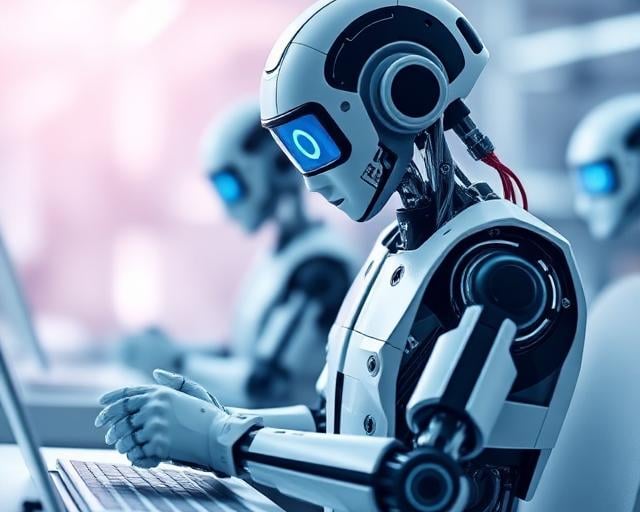
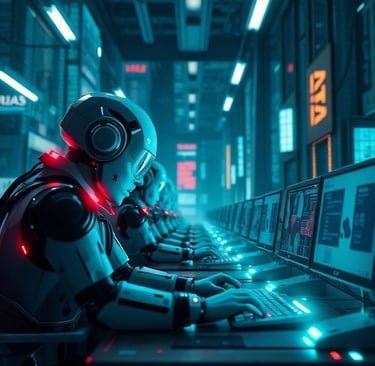
Automation has rapidly evolved from a futuristic concept into a central force shaping modern business. Across industries—from manufacturing and logistics to finance, healthcare, and education—companies are investing heavily in technologies that can streamline operations, reduce costs, and improve accuracy. Yet despite these apparent benefits, automation has become one of the most polarising topics in global business. The debate often centres on two key questions: Does automation create more opportunities than it destroys, and who ultimately benefits from this technological shift?
According to a 2025 report by the International Labour Organisation, nearly 23% of jobs worldwide are expected to be significantly altered by automation within the next decade, while approximately 9% may disappear entirely. Supporters of automation argue that such technological disruption has historically led to the creation of new types of work. They point to data from the World Economic Forum indicating that 97 million new roles could emerge in areas such as digital operations, algorithmic auditing, and AI coordination. From this perspective, automation is not a threat but a catalyst for long-term innovation.
However, critics warn that these new jobs will not necessarily compensate for the immediate losses in traditional sectors. Low- and middle-skilled workers are especially vulnerable: manufacturing roles, administrative positions, and customer-service jobs are among the most exposed. Economists note that even when new roles emerge, they often require higher qualifications and specialised competencies that displaced workers may not possess. This mismatch, known as the "skills gap," has widened significantly in the past five years. A study from Oxford Economics suggests that for every one high-skilled job created by automation, at least three low-skilled jobs may be eliminated.
The controversy doesn't end with employment. Automation also carries serious ethical and managerial implications. Companies increasingly rely on AI-driven systems to make decisions about credit scoring, hiring, performance evaluation, and even disciplinary actions. Yet algorithms are not neutral. Several investigations—from the European Commission to independent digital-rights researchers—have shown that machine-learning systems can reproduce and even amplify existing societal biases. For example, one 2024 audit of automated recruitment tools found that applicants from minority backgrounds were up to 28% more likely to be screened out due to biased pattern recognition.
Corporate leaders claim that automation enhances efficiency, reduces human error, and strengthens competitiveness—outcomes they argue are essential in a global market shaped by macroeconomic volatility. They also point out that the cost of failing to automate can be severe: between 2020 and 2024, companies that did not adopt automation technologies saw an average productivity decline of 14%, according to a Deloitte industry survey.
But employees often see the issue differently. Several European trade unions report rising distrust as workers fear that automated monitoring systems—tracking keystrokes, emails, movement, and productivity metrics—blur the line between performance management and digital surveillance. In a 2025 survey of 12,000 employees across the EU, 61% stated they felt less trusted by their employers due to automated monitoring practices.
Governmental responses remain fragmented. Some countries have introduced strict regulatory oversight, requiring companies to perform algorithmic transparency checks, while others have opted for more business-friendly policies. The result is a global landscape in which automation is accelerating unpredictably. Economists warn that without consistent governance, the risks could outweigh the benefits.
Ultimately, whether automation becomes a threat or an opportunity will depend on how businesses, policymakers, and workers navigate the transition. Automation itself is not inherently harmful; its impact is shaped by the choices humans make about how to implement it. Companies that prioritise strategic foresight, invest in workforce reskilling, and adopt transparent governance may position themselves to benefit from technological change. Conversely, organisations that ignore ethical concerns or rely solely on automation to cut labour costs risk long-term instability.
As the global economy undergoes profound geo-economic shifts, automation sits at the centre of one of the most important debates of our time. The question is no longer whether automation will transform work, but whether societies can adapt quickly enough to shape that transformation responsibly.
4. Grammar Focus
A. Inversion for Emphasis
Rewrite the sentences using inversion for emphasis:
I had never seen such rapid automation before.
Companies realized the consequences only after the layoffs began.
Workers protested so loudly that management had to respond.
Technology has rarely advanced so quickly.
Employers understood the ethical risks only when the scandal broke.
The government will intervene only if the economic impact becomes severe.
B. Mixed Conditionals
Complete the sentences:
If companies had invested earlier in automation, they ___ (be) more competitive today.
If employees trusted management more, productivity ___ (increase).
If the economy were stable, investors ___ (not withdraw) their capital last year.
5. Final Task – Creative Presentation Challenge
Choose ONE of the following creative business tasks. Your presentation should be 2–3 minutes, use at least two advanced vocabulary terms, and include one statistic, one prediction, and a controversial argument.
Option A: "Boardroom Drama – The Automation Crisis"
You and your partner are executives at a global company. Automation has just caused a massive shift in your workforce. Present:
What happened
Who is affected
Your controversial proposed solution
A prediction about the company’s future
Option B: "Future News Report 2035"
Imagine you're journalists reporting from the year 2035. Create a news briefing on how automation changed:
The global economy
Employment
Corporate power structures Include at least one shocking statistic and a bold prediction.
Option C: "Pitch an Ethical AI Startup"
Invent a startup that solves a modern ethical challenge caused by automation. Explain:
The problem
Your innovative solution
Why investors should support it despite risks
One controversial statement about your competitors
Option D: "Debate Show: Automation – Hero or Villain?"
Host a mini-talk-show segment where you argue one extreme position:
Automation is the best thing that ever happened to business OR
Automation will destroy the global workforce Use emotional storytelling and advanced vocabulary.